
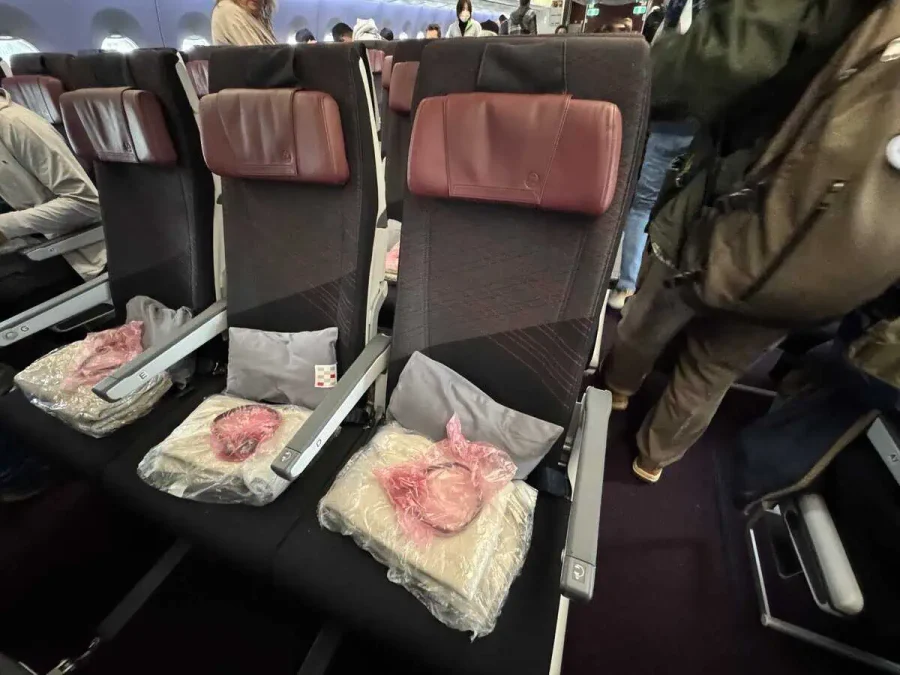
I took a one-week vacation to Japan, and I wanted it to be a bougie flight experience in First or Business Class to or from Japan. And I failed. But! Flying Japan Airlines in the back of the plane was pretty great! Check out my review of Japan Airlines A350-1000 in Economy Class below!
Flight Info
| Date Traveled | November 29, 2025 |
| Flight No. / Route | JL 11 / DFW-HND |
| Aircraft / Tail | A350-1000 / JA-10WJ |
| Flight Time / Distance | 13 hours, 10 minutes / 6462 miles |
| Departure / Arrival | 10:35AM DFW / 3:25PM+1 HND |
| Class / Seat | Economy Class / 46D |
| Method / Cost | Nonrev-ZED / $109.40 |
| Loyalty Status | N/A (AAdvantage number not tied to this) |

Summary
- Brand new aircraft so the cabin and seats are still in great condition
- Japanese service and hospitality shine through the cabin crew’s professionalism
- Seat features are top-notch
- Best Economy Seat in 2025
- Lunch service presentation and food was great
- Lavatories have bidets
- Ice cream was TOO frozen. THE. WORST.
- Bluetooth headphones cut out every so often
- No WiFi connection until 2 hours into flight
- Booking Japan Airlines A350-1000 Economy Class
- Packing for Japan Airlines A350-1000 Economy Class
- DFW Airport Check In and Security/Customs
- Lounge at DFW
- Boarding and Departure for Japan Airlines A350-1000 Economy Class
- Japan Airlines A350-1000 Aircraft
- Cabin and Seats in Japan Airlines A350-1000 Economy Class
- Inflight Entertainment in Japan Airlines A350-1000 Economy Class
- WiFi in Japan Airlines A350-1000 Economy Class
- Inflight Service in Japan Airlines A350-1000 Economy Class
- Food and Drink in Japan Airlines A350-1000 Economy Class
- Lavatories in Japan Airlines A350-1000 Economy Class
- In-Flight in Japan Airlines A350-1000 Economy Class
- Arrival at HND
- Other Stories to Share
- Lessons Learned from Japan Airlines A350-1000 Economy Class
- Bottom Line
Booking Japan Airlines A350-1000 Economy Class
I had a little bit of a rough time booking this flight. My ultimate goal was to book Japan Airlines First Class on their shiny new A350-1000 aircraft that they took first delivery of in 2023 and have slowly been acquiring more. And … I didn’t luck out this time. What’s crazy is I saw First Class availability on other routes but for their B777-300 aircraft, which I’ve already experienced (and will hopefully re-share here one day). I really want to try their new First Class because of the new innovations, privacy, space, and typical JAL service and hospitality.
Flight benefits…maybe?
So my backup plan was to utilize my flight benefits. My airline started acquiring Business Class standby agreements for employees with a growing list of airlines this year, and I thought maybe I could utilize one of them to get to Japan. But! That might have required me to go to Australia, Philippines, Finland, or Germany. Wild options, I know. For a week or two, I was monitoring flight loads (like how open the flight is with available seats), and Australia or the Philippines seemed viable. However, to make this all work would’ve been costly with all the taxes and fees as well as time spent in the air and layovers.
The other option was to utilize my own airline to fly to Japan. However, Business Class seats were quickly evaporating in availability with increasing competition amongst other fellow employee travelers.
In the end, after much consideration and research, two nights before departure, I decided to fly Japan Airlines—still on their A350-1000 but in Economy as my airline doesn’t have a premium cabin agreement with them.
To do this, I utilized an internal website/portal where airline employees can book and list for such types of air travel (ZED travel for my fellow airline employee readers). To fly from DFW to HND was $109.40 in taxes and fees. Not bad considering that booking this flight last minute with a paid ticket would’ve been something like $1400!
I booked this flight the day before departure.
Packing for Japan Airlines A350-1000 Economy Class
With Japan trips, I know I’m often tempted to bring checked luggage in order to have space to bring stuff back. I used to do this when I was going back and forth for work pre-COVID.
For this trip, I decided to bring my carry-on rollaboard and backpack—my usual setup. And this setup was in keeping with Japan Airlines’ carry on policy.
I packed enough clothes for the week in my rollaboard, and my backpack still had space to expand if I brought stuff back with me. Also, the upcoming week in Tokyo was going to be cold, so I packed some long sleeves and other things to keep warm.
To make this flight more comfortable, I made sure to bring my typical eye mask, my AA Business Class slippers to change into, my Bose wired noise-canceling earbuds, Apple AirPods Pro’s with noise cancelling, and some packets of electrolytes to mix with water in my water bottle. I also packed my backpack such that electronic stuff I’d like to use during the flight were within easy reach (like power cords, my Nintendo 3DS, headphones, etc).
DFW Airport Check In and Security/Customs
Due to being gone for a week, I opted to keep my car at my house and just have my parents drop me off at the airport. They dropped me off about 3.5 hours before departure at DFW Terminal D, though I had them drop me off at the American Airlines counters knowing I had some time to kill before Japan Airlines opened up their own counters.
This being the weekend after Thanksgiving, it was pretty busy at the AA counters and adjacent TSA PreCheck checkpoint.
Checking in at the Japan Airlines Counter
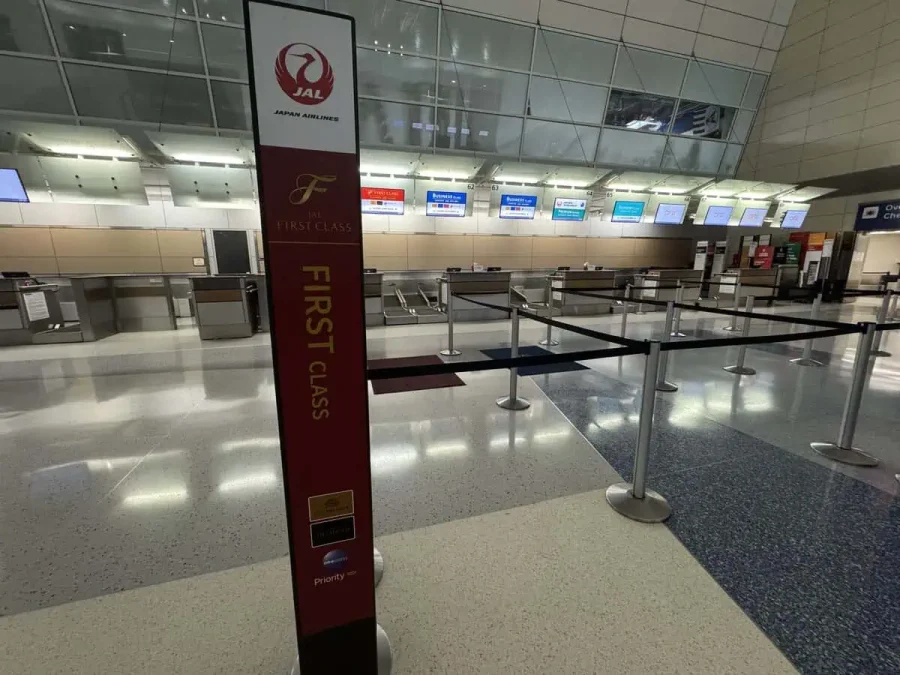

The Japan Airlines (JAL) counters were located at counter numbers 60-65 as you can see in the picture above. I’m not sure if this switches around because the counters are all generic.
I arrived about 10 minutes before JAL opened their counters, and when they did, I got in line.
Because DFW is an international outstation for JAL, I wasn’t surprised to see contract agents working the ticket counter.
When I checked-in, I told the agent that I was a “staff traveler”. This seems to be the universal phrase to indicate that I was flying nonrevenue standby on another airline that isn’t my own airline. And the agent, indeed, understood what I meant.
The agent verified my passport, saw my itinerary, and printed me off a standby card that I could use to get through security. She also pointed out that the standby card showed when to show up at the gate to get my seat assignment (about 9:35AM). She did not weigh or measure my carry on bags.
After checking in, I made my way over to the adjacent TSA checkpoint.
TSA and Security
When I walked past the General checkpoint by the Grand Hyatt entrance, I saw that it had a 16 minute wait. Lots of people–mostly AA passengers, I thought, since at some point in 2024, DFW Terminal D made it such that security checkpoint by the AA counters was just purely PreCheck.
Because there aren’t many morning international departures with other airlines at DFW, the international TSA checkpoint wasn’t that busy at all—just a two minute wait! And I think it only took me about two minutes! So easy.
I’ll note that… because of the way I booked, I don’t think my Known Traveler Number got passed along so I wasn’t able to use PreCheck. Not a problem. I only had to remove my laptop, and the line moved decently quickly.
Lounge at DFW
| Name | Admirals Club |
| Location | Terminal D, near gate D24 |
| Time Visited | 7:40AM |
| Access due to… | Citi Executive credit card and flying oneworld (even if standby!) |
Knowing that my departure gate was going to be at Termainl D, I decided to see about hitting up their Admirals Club here.
Now, I actually wasn’t sure if I would have access because I wasn’t flying an AA flight. But after double-checking the Admirals Club access rules on AA’s website, I saw that for passengers with the Citi AAdvantage Executive card, access is granted if you’re flying even on a oneworld airline, which JAL qualifies. There was also the matter of me flying standby and not having a confirmed seat, but that wasn’t an issue to get in.
When I checked into the Admirals Club at Terminal D, I asked the club agent, and she went over this same info and let me through.
During check-in, I also saw Japanese men carrying around the Flagship pass that allows access to the Flagship Lounge adjacent to the Admirals Club. This pass is only for passengers with high status or flying in a premium cabin. Man, that used to be me! lol
My backup plan if I didn’t have access to the Admirals Clubs would have been to try and use my Priority Pass benefit and check out The Club DFW maybe. Or go do some morning drinking at a bar.
Once inside the Admirals Club, I looked around for a place to sit and luckily found one right by the windows overlooking D25, which had a beautiful AA B787 parked at it in preparation for the Shanghai flight.
Food Offered at the Admirals Club
Today’s food offerings included corned beef hash and breakfast potatoes for the hot food (see pic below). The potatoes didn’t look appealing to me so I opted for the hash and paired it with a muffin and raspberry chia pudding.
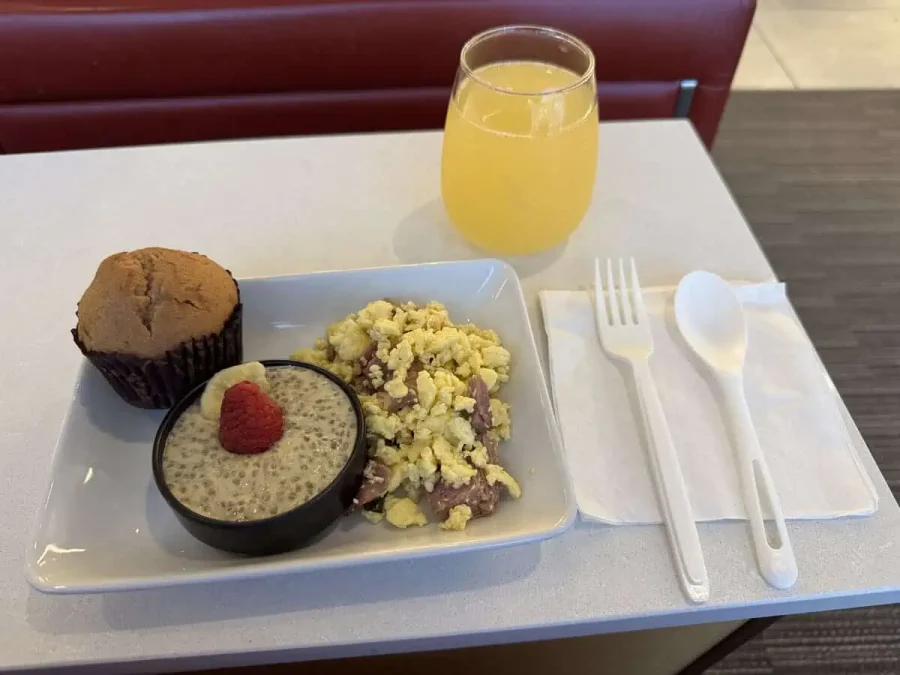
The hash was kind of salty, but otherwise it was good. The best part was the chia pudding—not too sweet with a good tapioca-like texture. On the other hand, I was most disappointed with the muffin as it was dry. To wash this all down, I had gone to the bar and requested the sparkling wine/brut and splashed it with orange juice from the drink area for a mimosa.
With it being a Saturday morning of Thanksgiving weekend, I didn’t find the Admirals Club to be super busy, but more and more people trickled in as time went on during my 1.5 hour stay.
One thing I observed is that multiple passengers BROUGHT THEIR DOGS. Leashed and not in their carriers! I heard a few barks periodically. I…think I’m “Team No Dogs In Airline Lounges” because these places never have pet relief areas. But at the same, I’m a dog guy and don’t really have a problem if the dog is well-behaved. No one got bitten today, which was good.
Other than that, it was a good, relaxing time in the lounge wherein I looked out the window a lot, enjoyed my lite breakfast, took notes for this flight review, and texted friends.
Boarding and Departure for Japan Airlines A350-1000 Economy Class
| Scheduled boarding | 10:05AM |
| Actual boarding | 10:04AM |
I left the Admirals Club around 9:00AM because I wanted to see if I would run into a coworker (also departing for Japan but with AA…. Narrator: He did not meet with his coworker), and to also make sure I was at my departure gate around 9:35AM for my seat assignment as instructed by the ticket agent and my standby pass.
When I arrived at Gate D14, I saw that the gate agents were busy making preparations and the cabin crew was gathering and having a meeting. Gate D14’s seating areas are spread out so it was hard to tell if the people around were really for this Japan Airlines flight or not. An hour before departure, there were still plenty of seats available to sit in. I decided to sit in the seats close to the blue art installation that the surrounding gates kind of encircle.
As departure time drew nearer, the gate agents made several announcements, especially looking for a handful of passengers that they kept paging over and over again (not sure why). From where I sat down, I could hear the PA announcements very clearly.
Just after 9:35AM, I walked up to the gate agent and asked about my seat assignment. As the gate agent was typing away, I indicated that I’d like an aisle seat if available. After some more typing, I got my confirmed seat assignment: 46D! And apparently this came with Group 5 boarding, which is the last boarding group.

It took me a little while to see and understand that everyone was lining up according to their group numbers and corresponding stanchions the gate agents had set up. I saw that Group 4 and 5 were combined on a single stanchion over by me, so I let the line fill up a little before jumping in. One thing I noticed is how all these boarding lanes got filled with people, and I couldn’t help but wonder where everyone was hanging out prior to getting in line!
Boarding time!
Boarding started a few minutes early with the preboards, but it took a while before Group 1 (First Class I think) was called to board. That happened around 10:11AM.
At 10:25AM, I was able to do the biometric scan (where they scan your face vs boarding pass) to board the aircraft. I did end up behind an elderly woman who was in a wheelchair, so things moved slow down the jet bridge and on the aircraft as she got wheeled in then seated.
For more information about Japan Airlines’ boarding priority, check this out.
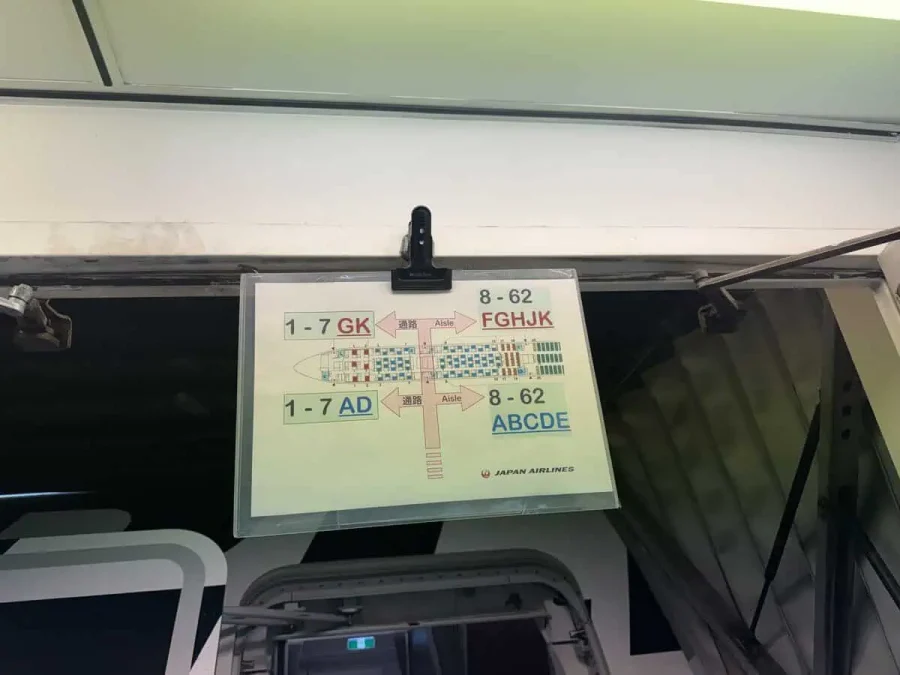
Just before getting on the aircraft, I saw that JAL had posted the sign pictured above that lets passengers know which side of the aircraft to go to depending on their seat number. I thought this was brilliant because it saves the flight attendants from having to check and verify with each passenger getting on the plane.
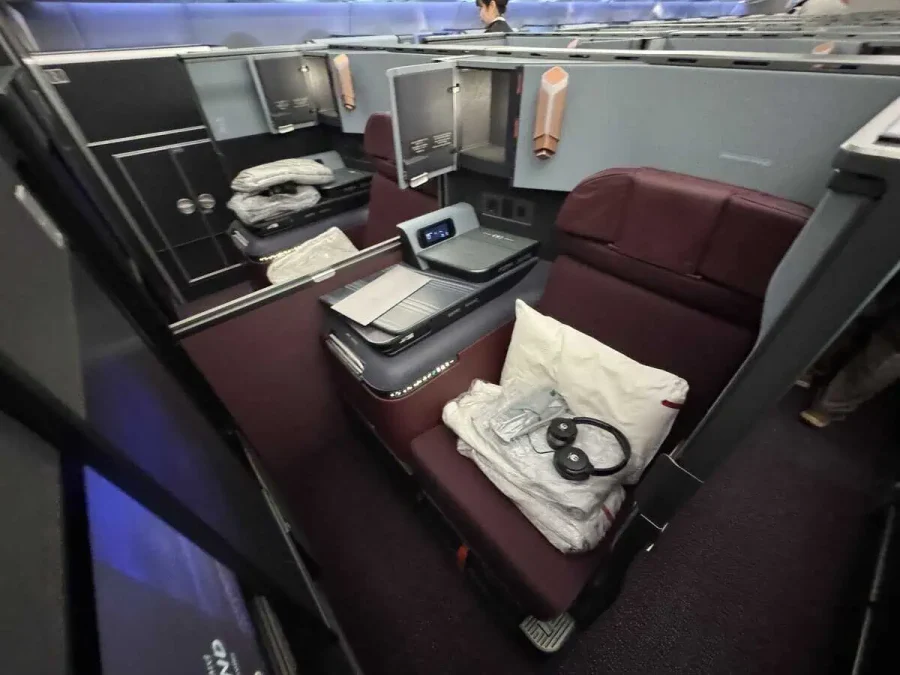
When I got to my Economy Class seat, I saw there was plenty of bin space around me. I did learn that my rollaboard luggage didn’t fit in the bookend way as is typical for say AA domestic flights. No one ended up using the bin besides me, which was weird and really nice haha.
I had other observations during the boarding process…
The temp of the cabin seemed cool, likely due to it having been a colder morning.
By 10:30AM it seemed like most everyone had boarded.
And by 10:34AM the cabin crew stood at their stations AND THEN BOWED. Then it was time to prepare for pushing back, which we did right on time at 10:35AM. This was crazy to me because most of the plane didn’t start getting on until 10:11AM. And we had an A350-1000 to fill!
So there wasn’t really a delay in the boarding process. Somehow.
The one annoying thing about boarding is that the men on either side of me (one across the aisle, and other on the opposite aisle seat) were both on their phones. With their speakerphones on. Ugh. Luckily, their calls didn’t last TOO long, and both had hung up their calls before we pushed back.
Overall, the boarding process was incredibly efficient and smooth. Somehow we boarded the plane and all flight attendants were done with their duties within like 25 minutes. If only US-based airlines could be this efficient!
Takeoff
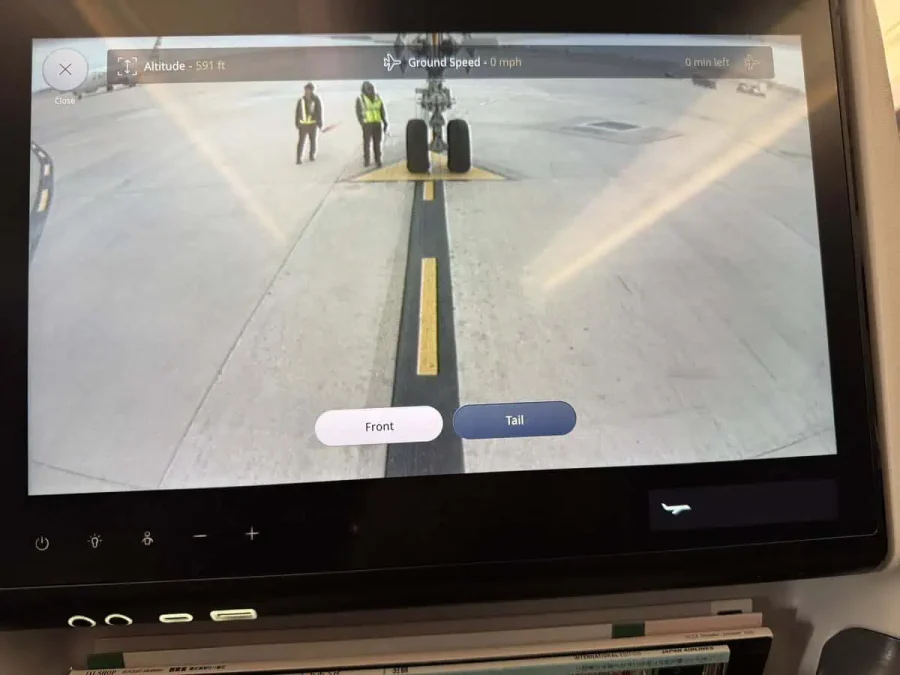
Before taking off, there was a little bit of a noticeable pause as we idled at runway 36R-18L for a while. I figured that we were waiting on ATC. I did have the tail and nose cams on the IFE system on during this time. See below for more info about that!

Summary of timings during boarding and departure:
| Scheduled departure | 10:35AM |
| Boarding complete | 10:28AM |
| Boarding door closed | ???? (Too far away from it; they didn’t announce this like AA does) |
| Pushed back from gate | 10:35AM |
| Take off | 11:00AM |
Japan Airlines A350-1000 Aircraft

This flight was actually not my first time flying an A350 aircraft. That honor belongs to SQ 23 – the World’s Longest Flight from JFK to Singapore. However, Singapore Airlines utilizes a special variant of the A350-900 for that flight. So technically, this Japan Airlines flight was my first time flying the A350-1000 variant.
In preparing this blog post, I learned that the -900 is more suited for long range routes, and the -1000 is better for long-haul premium routes.
The aircraft for this flight was registration number JA-10WJ. Apparently, this was the 10th A350-1000 for Japan Airlines! And I flew it 2.5 months after they received it!
Cabin and Seats in Japan Airlines A350-1000 Economy Class
The cabin in Economy Class on Japan Airlines A350-1000 had a tasteful modern look to it. The sidewalls were a light gray, and the carpets were dark red with black accents. During boarding, the lighting was set to a white light so I could really appreciate the colors of the cabin. The picture shown below gives some of an idea of what the cabin looks like.

As far as wear and tear in the cabin, I didn’t really see anything obvious. Like I mentioned above, this aircraft is pretty new–only a few months old. Also, I know Japanese culture does a much, much better job of taking good care of things. With all that said, I can say the same thing impeccability about the cleanliness of the cabin.
In Economy Class, the configuration was 3-3-3, which is pretty standard for A350 aircraft. For wide bodies, I’m familiar with the similar configuration on B787 aircraft, but the A350 aircraft is wider than a 787 so that allows the seats to be a little wider. For Japan Airlines’ layout in Economy, there were 155 seats total—all in one cabin.
As for the overhead bins, I don’t think they were Airbus’ XL bins. My rollaboard didn’t fit on its side with the wheels facing away so I had to lay it hotdog style for the bin to close. I also suspect that for the most part, carry-on luggage in Japan are smaller than the standard American ones.
Overall, I thought the cabin noticeably looked sleek and new. Additionally, I thought it felt spacious with 9 abreast seating. Looking at the overall layout, I initially thought that the lavatories closest to me were only for Premium Economy due to the curtain placement, but this wasn’t the case for most of the flight.
While writing this review after the flight, I learned that Skytrax, which runs the world’s largest passenger satisfaction survey and gives awards to airlines, awarded Japan Airlines with the Best Economy Airline Seat in 2025. I’m not really sure if that award is specifically for the A350-1000 Economy Seat, but I’m willing to bet a sushi roll that it is.
Economy Class Seat on Japan Airlines A350-1000
My seat was 46D. It was a left-hand aisle seat in the center section of the cabin.

The seat model was a Recaro CL3710 according to Aerolopa. Japan Airlines configured it with a good handful of notable features:
- 33” pitch
- 18” pax width
- 5” recline (I feel like it was a little less than this)
- 13” 4k touchscreen (Panasonic?)
- Headphone dual RCA jacks
- USB C
- USB A
- Volume and power
- Bi-fold tray table with separate cup holder
- Literature pocket (upper) … with magazines!
- Skyward (JAL’s inflight magazine)
- Instructions for how to use features of the seat
- Instructions for WiFi
- JAL Shop (JAL’s shopping catalog)
- Literature pocket (lower)
- Safety card
- Motion sickness bag
- Two mesh outer pockets for small things/devices
- Universal power port
- Armrest audio jack — this is nice in that your cord doesn’t get in the way!
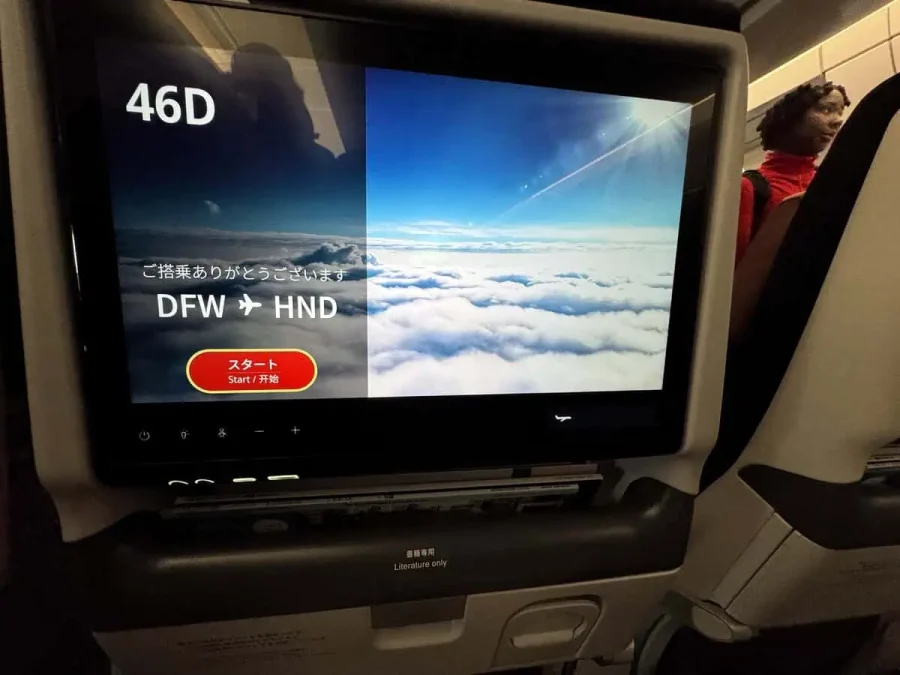
In the picture above, you can see the 13″ screen, but it doesn’t do it justice as to how nice of a screen it was! Also, just below the screen were the controls, the ports, and below that was the upper literature pocket.

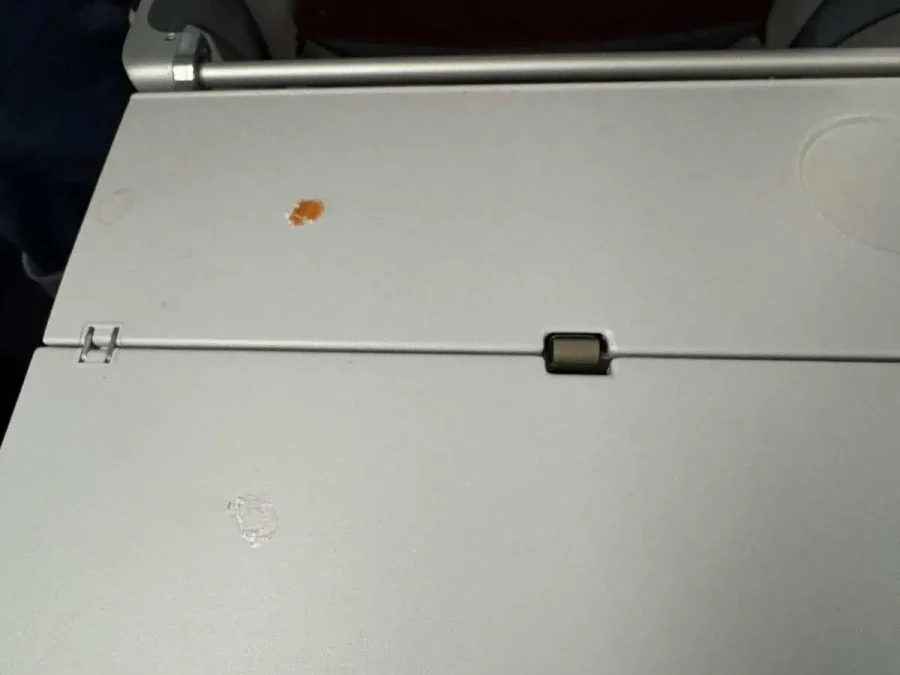
The seat features a bi-fold tray, which means you fold it out twice–once for a half-table and again for the full table. This design is typical when seat companies want to be able to offer more features or bigger screens to the back of the seat. Unfortunately, I found my tray table to be dirty when I unfolded it…but! I easily fixed it during meal service.
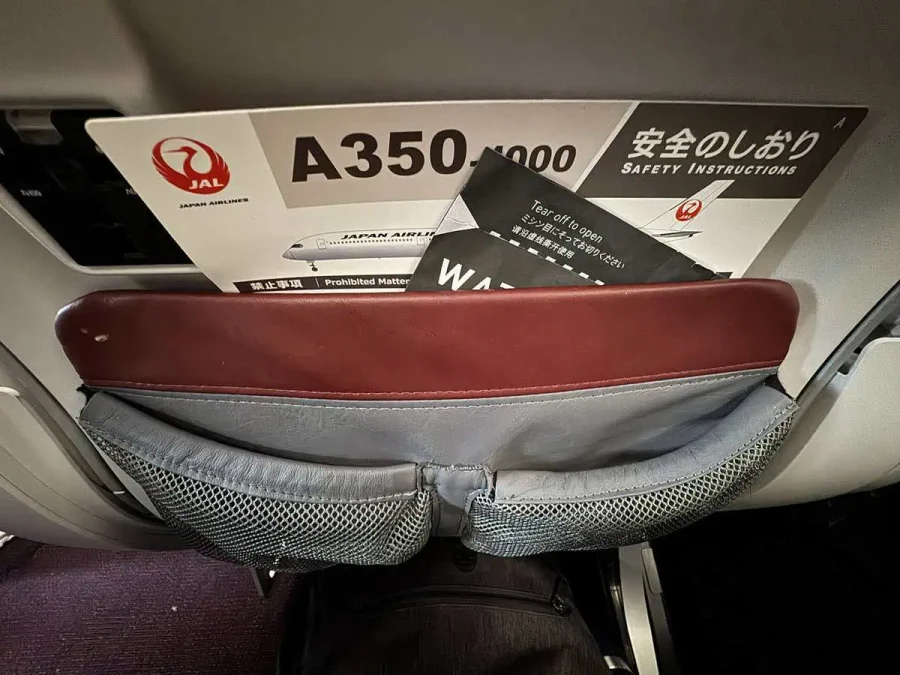
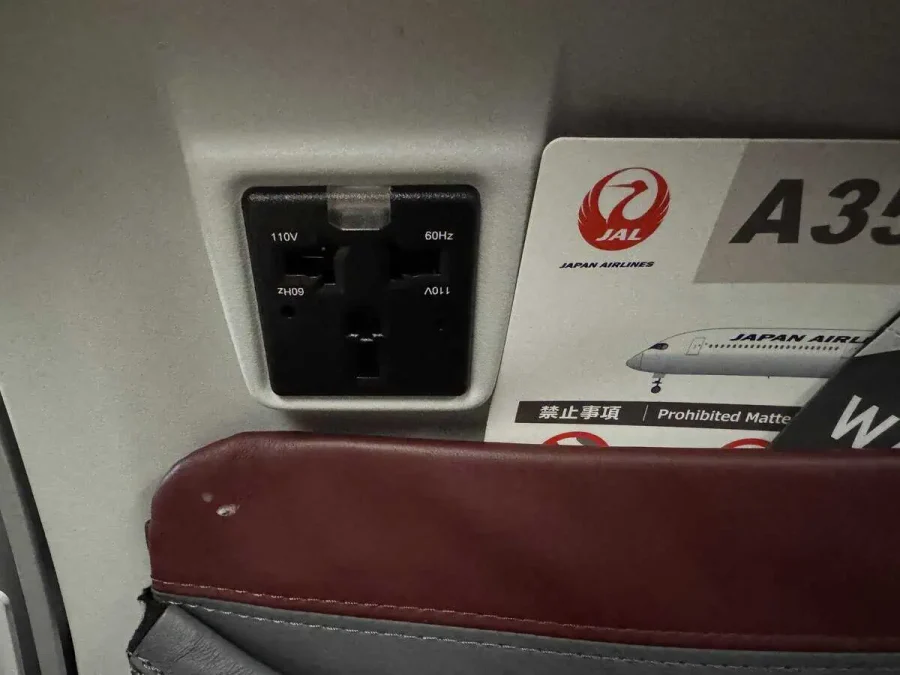
The bottom literature pocket has the universal power port, safety card, motion sickness bag, and extra mesh pockets. These mesh pockets came in clutch during the flight as this was where I stored my phone, AirPods case, and other small things when I wasn’t using them.
As shown below, Japan Airlines included a pillow, blanket, and cheap headphones as amenities for the seat. There was no amenity kit.
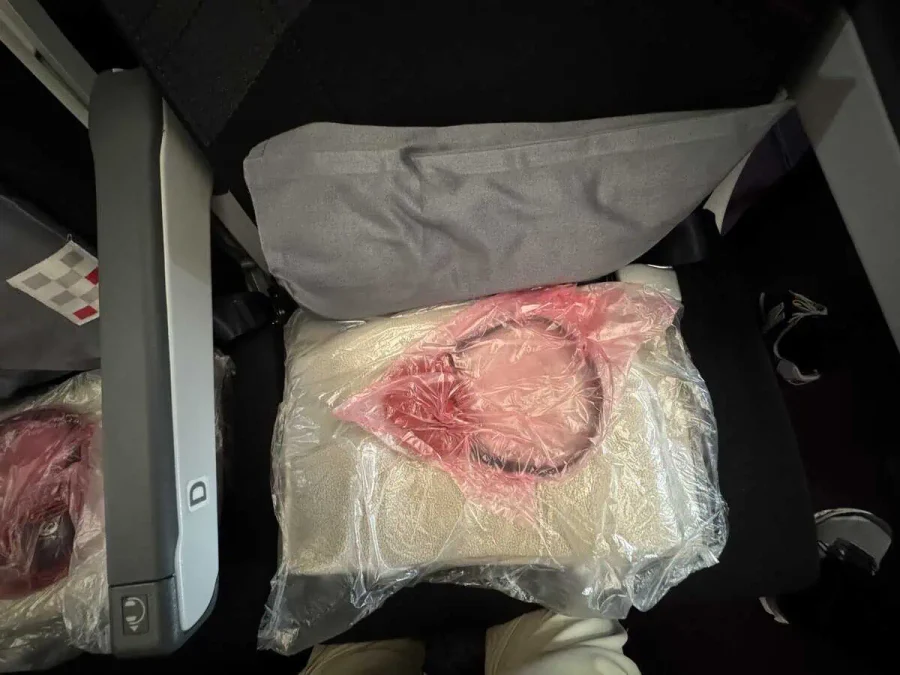
I didn’t use the headphones at all, but I did use the pillow and blanket. The blanket didn’t feel cheap—it was fleece and felt like it too! The pillow wasn’t anything amazing, but I felt like it was a little more firm than what I’m used to with long haul flights on American Airlines.
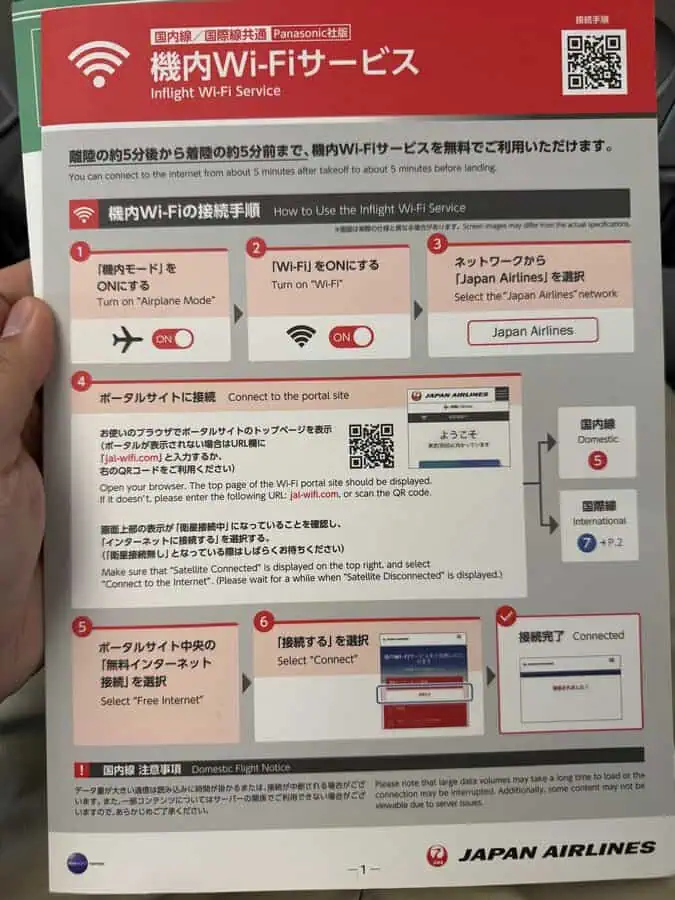
Also, the guide pamphlets (found in the upper literature pocket) for operating the features of the seat and how to connect to the onboard WiFi are pretty detailed in case you need help with those. See the pics below! But…does anyone really read these? Haha.

As for wear and tear on the seat, I didn’t see anything. Again, much like the cabin, the aircraft is relatively new to Japan Airlines’ fleet, and Japanese culture takes better care of their stuff.
For cleanliness, the only glaring thing was seeing some hard candy and residue on my tray table after deploying it (obvious in the picture above). Luckily, I was able to wipe that off with the oshibori (wet towelette) provided during the drink service. I was surprised to see that this was missed in cleaning the aircraft, but this didn’t merit me having to go complain to a flight attendant.
Looking back, I had a few favorite features of the seat. First, that 18” pax width was noticeable. Prior to this flight, I had flown to Santiago, Chile in American Airlines B777-200 Main Cabin, and I think those seats are an inch less wide. It didn’t take much for my hips to touch the sides of the armrest. Here on this flight, I felt like I had decent space. The touchscreen monitor was very nice—I really think it was the star feature of the seat! See below for more details. I was also impressed that the seat featured two literature pockets! And both are utilized by the airline. And lastly, the mesh outer pockets on the lower literature pocket was really handy in holding my phone and smaller items for easy access convenience.
Inflight Entertainment in Japan Airlines A350-1000 Economy Class
Like I mentioned above, the 13” 4K touchscreen monitor was probably the star of this Economy seat on Japan Airlines A350-1000. At 13”, I believe this was one of the larger sizes for an Economy Class IFE screen. The interface was pretty easy to navigate–just needed to touch or swipe depending on what I wanted to do. I found it super easy to use, but I did also get lost in its menus, which some seemed redundant or required seemingly too many taps to get to the function I wanted.
The content is feature-packed though! The major content areas offered were:
- Movies & TV Programs
- Audio
- Reading & News
- Flight Map
- Aircraft Camera
- Inflight Shopping

For movies and TV programs, I saw a lot of older Hollywood movies, but not many recent releases. Oddly, I didn’t see a lot of Japanese content so that made me wonder if JAL does route-specific content loading?
Later in the flight, I utilized the Audio section and started listening to chill jazz music to help me sleep. And towards the end, to help me get in the mood of being in Japan, I found an album of anime songs. Overall, there were various full albums of varying genres, podcasts, and audiobooks available for listening.
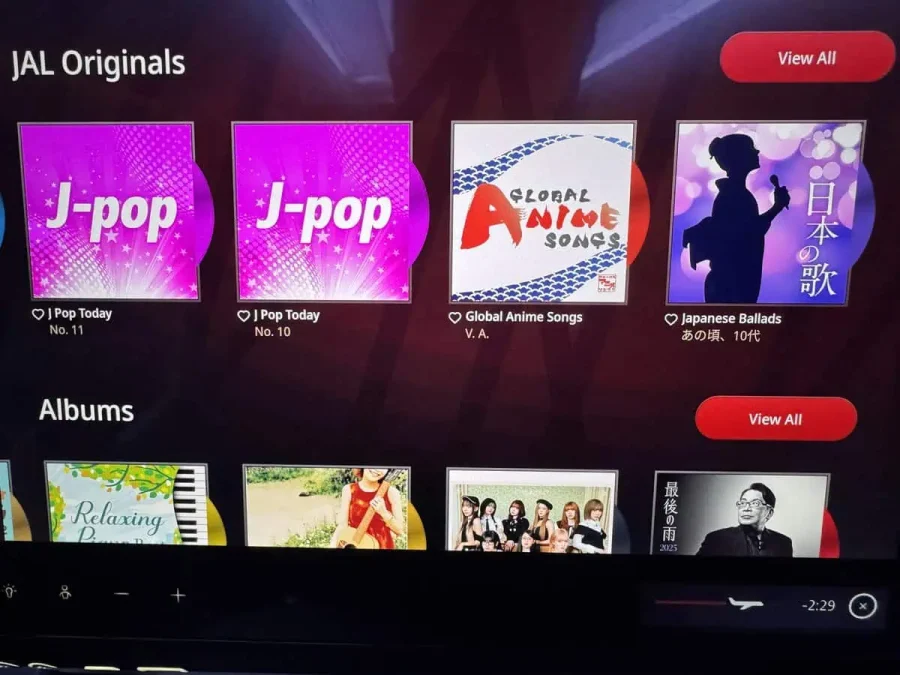
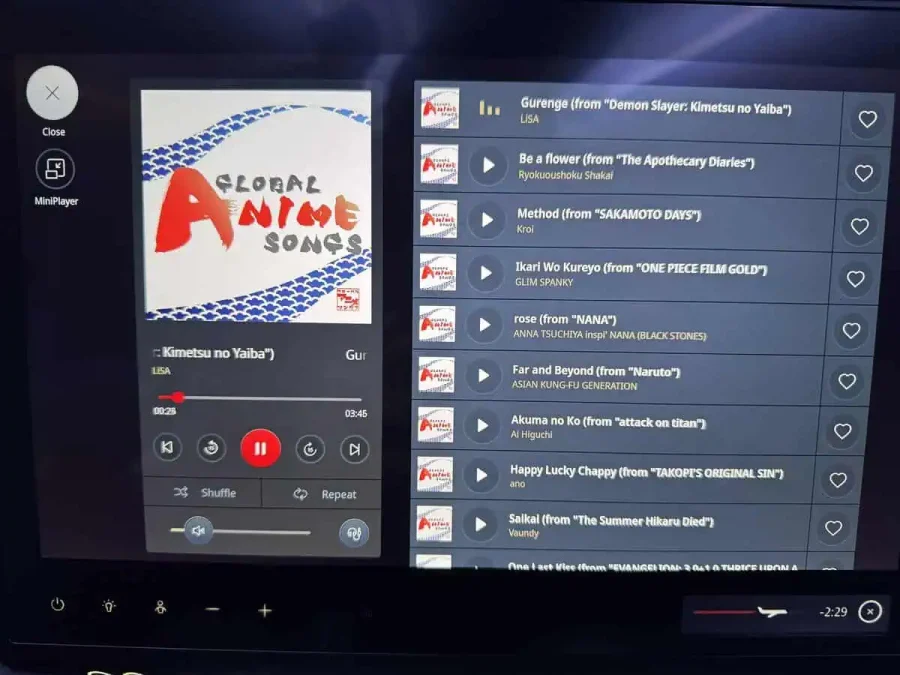
I didn’t really bother with the Reading & News section so I just assumed it had pre-loaded books, maybe manga, and live news channels.
Frequently throughout the flight, I had the Flight Map autoplaying. I thought it was pretty slick and intuitive to switch around with different views and information about the flight.
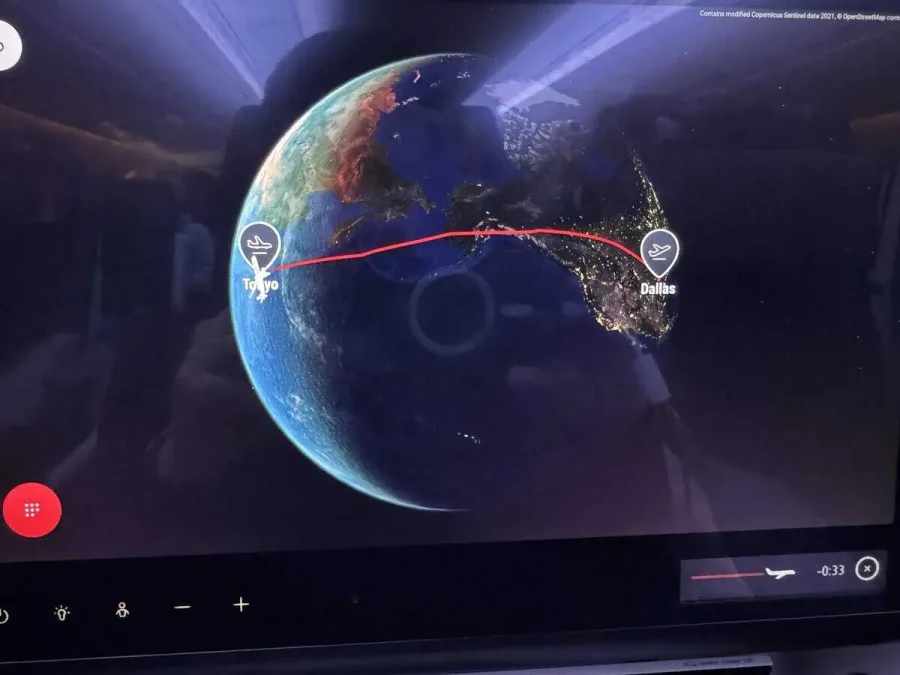
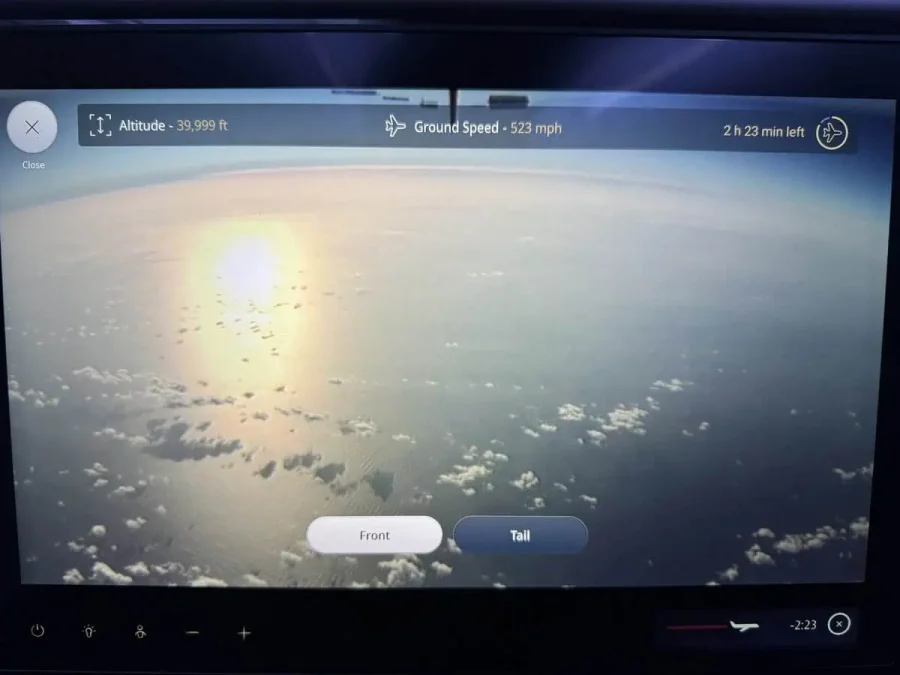
Now…the Aircraft Camera was probably my most fav part! The quality of the cameras were actually pretty dang decent as I’ve seen this feature on older aircraft on other airlines but they were sadly very grainy. There were two options: front camera which I think was forward of the nose landing gear, and tail camera with a great view of the top of the aircraft.
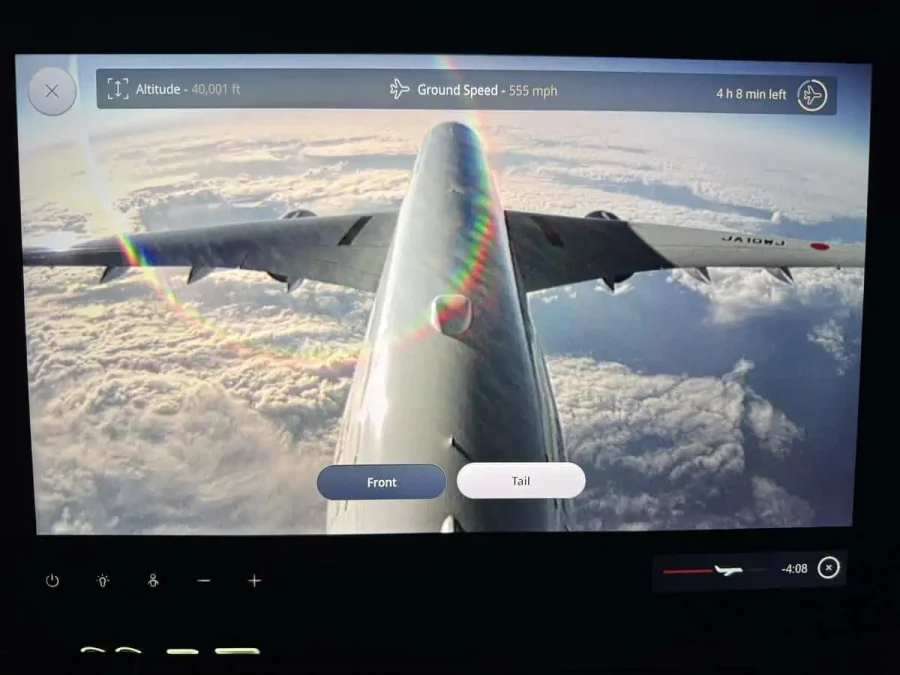
For Inflight Shopping, I didn’t really thumb through it but I know the idea of shopping on a plane for duty free items is a popular thing for Asian airlines. I didn’t have any interest in purchasing anything while on board this flight.
My favorite features
As far as cool features go, there were a few that stood out to me. Again, I really liked the external camera feeds, especially because the camera feeds weren’t super grainy like I’ve seen on other airlines. When using the system for the first time, it actually asks you to select one of three modes: personal (which is paired with the JAL app), default, and kids. I’m not a Mileage Bank member, and I am not a kid so I selected the default mode. However, if I was a Mileage Bank member and tied the system to my JAL app, the system can remember where I last left off in movies and TV shows! That’s pretty cool! I’m not sure if this works on JAL’s older IFE systems on their B777’s and B787’s though.
The last cool feature was being able to use my Bluetooth headphones with the screen! There was a button and instructions for it on one of the home screens. I was able to connect my AirPods to the screen, and that was really cool and convenient! I haven’t done that before as this was my first flight with that as an option! The screen still had dual RCA jacks in case I wanted to use wired headphones, whether with the cheap disposable ones provided or my own headphones with an adapter.
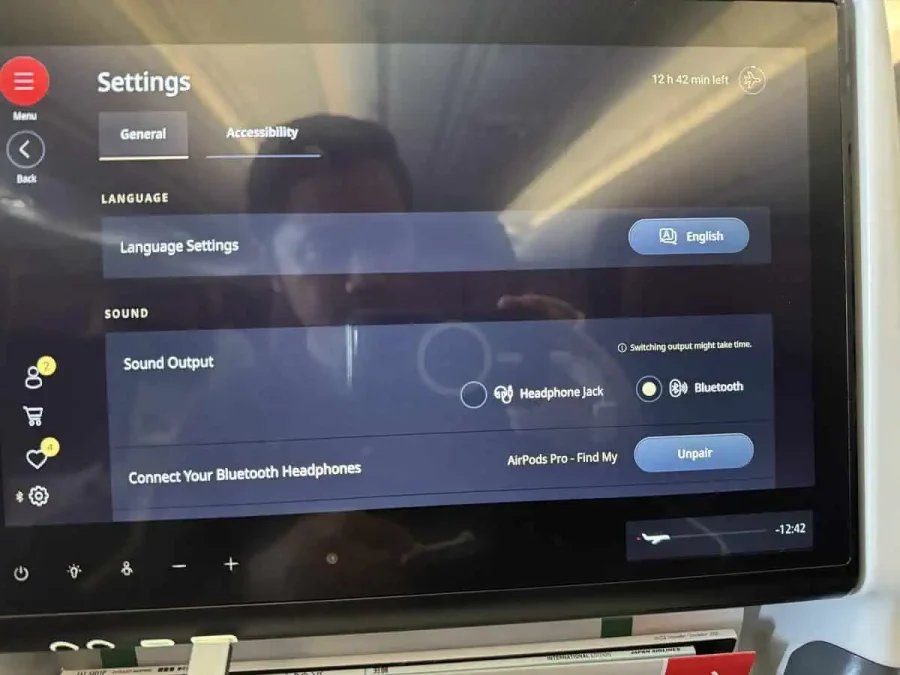
Overall, I really liked the inflight entertainment system! The controls were responsive and intuitive, although the menus were a little cumbersome. The external camera feeds were my most favorite part, and the inflight map was really cool too. I did end up watching three movies and listened to a few hours of audio (see below for my Inflight experience), and those worked pretty well. My one major complaint with the system though is that my AirPods lost connection every so often in the first half of the flight, and it took a little bit to reconnect. I was not sure of the cause, but I just rolled with it and tested my patience, haha.
WiFi in Japan Airlines A350-1000 Economy Class
WiFi was offered on this Japan Airlines A350-1000 flight from DFW to HND. But…not until well into the flight! I know Panasonic provides the service, but I am not sure of the nuances of how it works from a technical standpoint. Because I know some older systems require being at a certain altitude before the system works. Every so often, I checked my phone to see if the system was receiving a satellite signal, and it didn’t appear to have it until almost 2 hours into the flight! I mean..I was trying to test it out – for science! I wasn’t interested in doom scrolling all flight on social media.
To connect to the WiFi, there is a whole pamphlet with detailed instructions found in the literature pocket of the seat. But basically, you connect your phone to the WiFi signal and navigate to a particular splash page. On that splash page, it says the current status of the system, and if it works, it’ll give the option to pay for WiFi.
The different passes for WiFi were:
- Flight Pass (entire flight): $18.80 USD (I paid for this)
- 3 Hours: $12something USD (I forgot to take a pic! It doesn’t show you prices again after you’ve paid)
- 1 Hour: Free
I flew an American Airlines flight from DFW to NRT about 12 months prior to this flight, and that was $29 USD for 2 hours or $35 USD for the whole flight. So JAL offering a ~$19 USD flight pass was definitely a better deal.
WiFi Speeds
And as far as how fast the WiFi was:
- Download: 28.2 mbps
- Upload: 3.16 mbps
- Ping: 817 ms
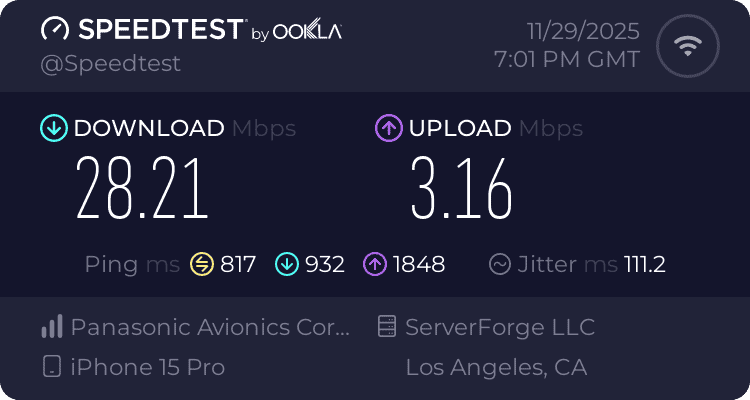
I was impressed with these speeds because having a download speed of 28 mbps is pretty comparable to hotel WiFi speeds at most hotels I’ve stayed at. But…the upload speed was not great and the ping was terrible. That same AA flight mentioned above, I had 7.86 mbps download speed, and 4.12 mbps upload speed, and that was on an older Panasonic system on AA’s B777-200.
For reliability, I thought I had pretty good and steady connection once connected. I noticed I had issues about 7.5 hours into the flight as it seemed like it stopped working, but I realized that maybe my phone got disconnected from the WiFi signal onboard and just needed to reconnect.
Inflight Service in Japan Airlines A350-1000 Economy Class
Note: I will say “cabin crew”, “cabin attendants”, and “flight attendants” interchangeably. JAL uses “cabin crew” or “cabin attendant” in reference to their crew.
I will just say, in general, Japan Airlines has a very professional cabin crew. They definitely look and act the part pretty consistently across the good handful of times I’ve flown them (even way before I started this blog), including this flight. They definitely conveyed Japanese hospitality and efficiency on this flight in Economy Class, though perhaps lacking a truly personal touch on this flight. I know if I were seated in First or Business, I’d likely be acknowledged by name. But still, even in Economy I was still convinced of their professionalism.
To me, what makes Japanese culture really cool is … the small details. For example, I noticed they used little sticker flags for people who have requested special meals and placed them at the top of the headrests so that other flight attendants were informed. This made the distribution of special meals pretty efficient. I also noticed that the cabin crew used lint rollers after every service to help clean up crumbs and such in the carpeted areas of the cabin. Just wow!
For the meal services on this flight, I think there were about 5 or 6 flight attendants serving the Economy Class cabin. There were always 2 on each side whether they ran the drink and meal carts down the aisles, but I assumed there were a few more in the galleys doing prep work.
Service Timeline
Here’s a timeline of what happened during the flight in terms of the inflight service:
(hh,mm after takeoff)
- 00,20 Wet towellete distributed (oshibori)
- 00,32 Drink cart arrives at me
- 00,46 Special meals delivered
- 01,03 Received my chicken entree and meal
- 01,29 Received my ice cream
- 01,34 Coffee and green tea served
- 01,45 Tray taken up
- 02,14 Cabin crew do JAL Shop service
- 02,30?? Lights turn off
- Mid flight: Orange juice and water served
- 06,58 Lights turned on
- 07,22 Drink cart arrives at me; midflight lite meal served
- 07,42 Lights off again
- 10,53 Lights turn on for pre-arrival meal service
- 11,12 Received pre-arrival meal
- 11,45 Tray taken up
- 12,15 Handed out customs forms
I wanted to point out some interesting things here with the timetable. They did a coffee and tea service right after the main meal service with pitchers of either drink. The cabin crew also did a similar thing with orange juice and water in the middle of the flight when the lights were off, and they offered these drinks to anyone who was visibly awake.
Another observation I had was during the main meal drink service. They had a drink menu with one side in Japanese and the other in English that they would show to each passenger to make a drink selection. I thought this was interesting, but I wish the drink menu had been available on the IFE screen like the food was. I’m not sure of the full drink menu, but I think the general sodas, water, juices, teas, coffee, alcohols, and speciality JAL Sky Time drinks were available.
I forgot to check if they set out snacks and drinks in the galley as is often typical for long-haul flights. I’ll assume that they did, but I didn’t notice.
Food and Drink in Japan Airlines A350-1000 Economy Class
For this 13 hour flight in Japan Airlines Economy Class on the A350-1000, the flight attendants served lunch, a midflight snack, and a pre-arrival meal.
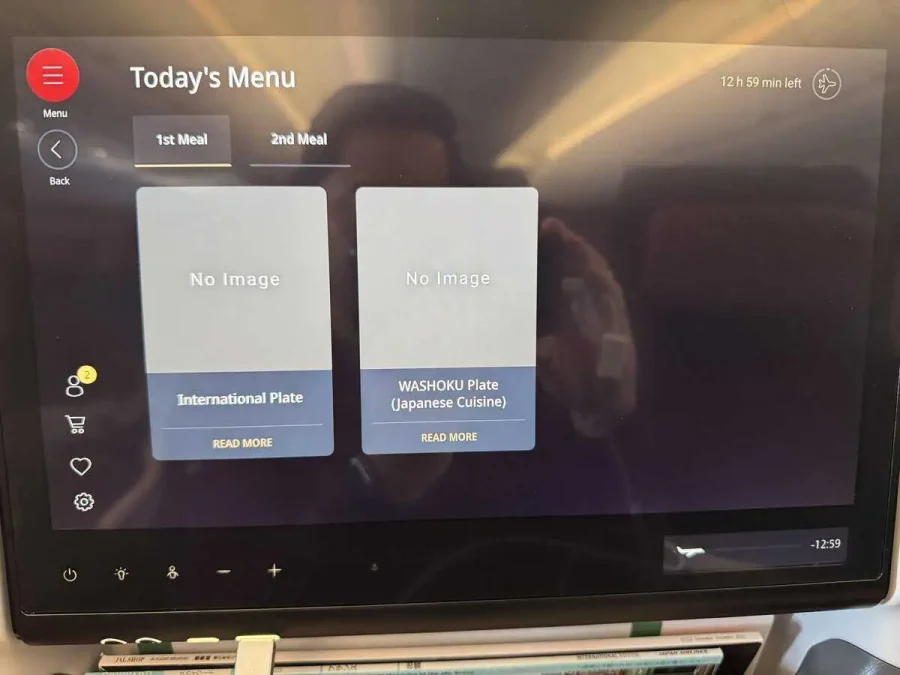
Like I mentioned above, the menu options for the lunch service and pre-arrival meal were available in the IFE system (though no pictures!).
Lunch Service
The two options, again, were either an international plate that had beef goulash or the washoku plate with grilled salted rice malt chicken.
First things first–a moist towelette was handed out to every passenger. I just laughed because they say “JAL Business Class” as you can see in the picture below! And you know what–that immediately elevates this Economy Class experience on JAL! Haha.
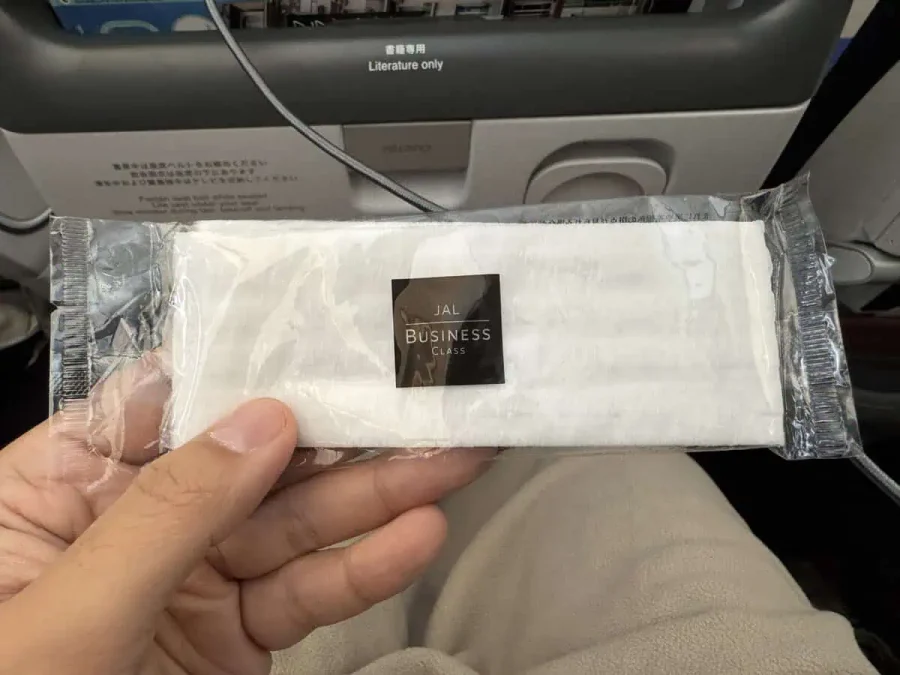
While the cabin attendants were in the galleys heating up the food, they also did a drink service down the aisles. I selected a highball, which is a whiskey mixed with soda water. I didn’t want to go heavy on the alcohol at the start. I’ll also note that none of the drinks cost extra.

Since I wasn’t in the very back, and the cabin attendants had started from the front of the cabin, I still had the two choices. I selected the grilled salted rice malt chicken.
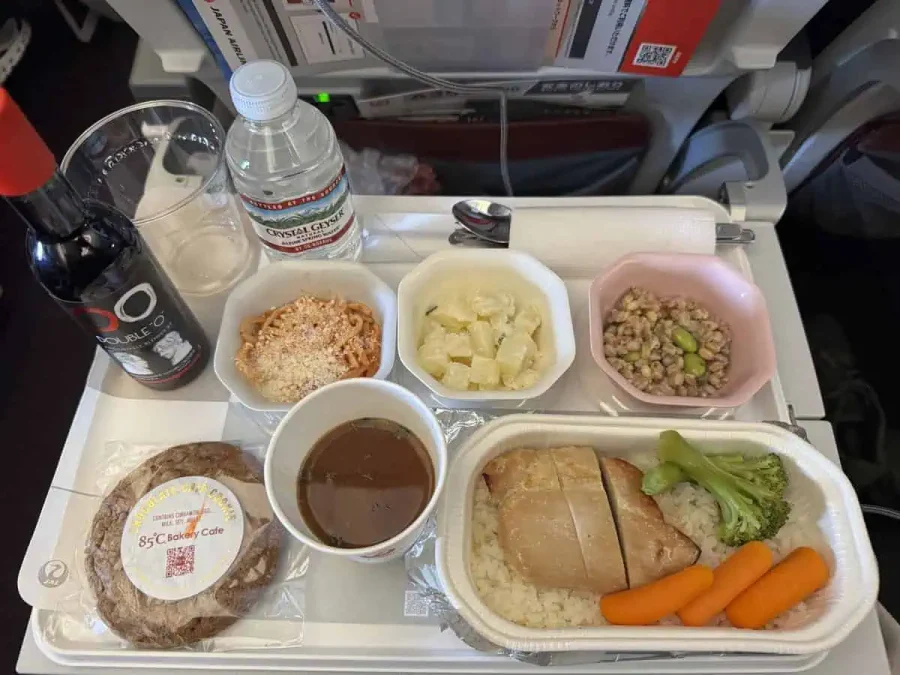
As you can see in the picture above, the tray was pre-set, and I thought the presentation was rather splendid. Everything fit, nothing felt super crowded. This stood out to me because typical long-haul American Airlines Main Cabin meals seem squished and crowded to me, often presenting a challenge to eat.
I also noticed that the sides were served in a hard, reusable plastic–I don’t think they get thrown away. And I also noticed the entree was served in a styrofoam, which I guess makes sense because this is the food item that gets heated in the galley ovens.
Another impressive thing to me was the use of actual silverware! In Economy! I know American Airlines started using bamboo cutlery, but the use of actual silverware by Japan Airlines made the Economy eating experience feel more premium! And of course, chopsticks were included with the silverware too.
Bear with me since Economy meals aren’t served in multiple courses so I don’t have pictures in-between to break up how the food was, lol.
The drink service came with rice crackers. Very giving pub-like since I had a highball. The rice crackers had a hint of sweet, but most certainly a savory flavor is what I remembered the most.
After the cabin attendant set down my tray of food, she also asked if I wanted miso soup. I said yes, and she handed me a small cup of miso soup. I was amused that they served it from a pitcher into a little cup, but I thought this was practical in Economy Class (from previous experience in their Business and First Class cabins, they served miso soup in the typical small black bowl). The miso soup was savory and hot.
Starting with the sides from left to right in the picture above, I saw there was spaghetti (?!), potato salad, and barley salad (I think?). I honestly don’t know what the official names were, and I wasn’t entirely sure about the last side dish being barley. The spaghetti was cold (intentional), and it had a tomato flavor giving it a nice, slightly acidic taste. For the potato salad, I appreciated that the potatoes weren’t mushy, and I thought that the herb seasoning was good. The mayonnaise didn’t have a strong flavor either–just enough to convince you of its creaminess. Lastly, the barley (?) salad had a great, slightly savory flavor, and the chewiness added a nice texture. All these sides paired well with the entree.
Regarding the main entree, it consisted of the malted chicken, rice, and steamed veggies. The malted chicken was slightly dry to me, but it had a good light and savory flavor. When I think of malt, I also think of something kinda cereal-like but I don’t think the taste was convincingly malty (either that or my palate isn’t developed for that!). The rice was plain, but was pretty good on its own, which is to be expected in Japanese culture. And lastly, I thought that the steamed broccoli and carrots had no flavor. Honestly, this main entree was relatively bland, but I think this highlighted the necessity of the sides to add more texture and flavor to the overall meal.
I shared a pic of this meal to some former colleagues of mine, and one commented how it looked like something a gym bro would eat–chicken, rice, and veggies. I agreed! Haha.
For dessert, there was a chocolate chip cookie that came with the tray, and a small Haagen-Dazs dulce de leche ice cream came later while everyone was still eating. I noticed that the cookie is from 85 Degrees Cafe, which I know to be a popular Asian bakery. The cookie was kinda hard but chunky, and I noticed and tasted bits of oats and cinnamon too. Pretty good though! The ice cream was the worst part of this meal–it was TOO frozen when they handed it out, and I had to wait for it to melt enough to actually eat it. Otherwise it was a great, sweet finish to this Economy Class meal!
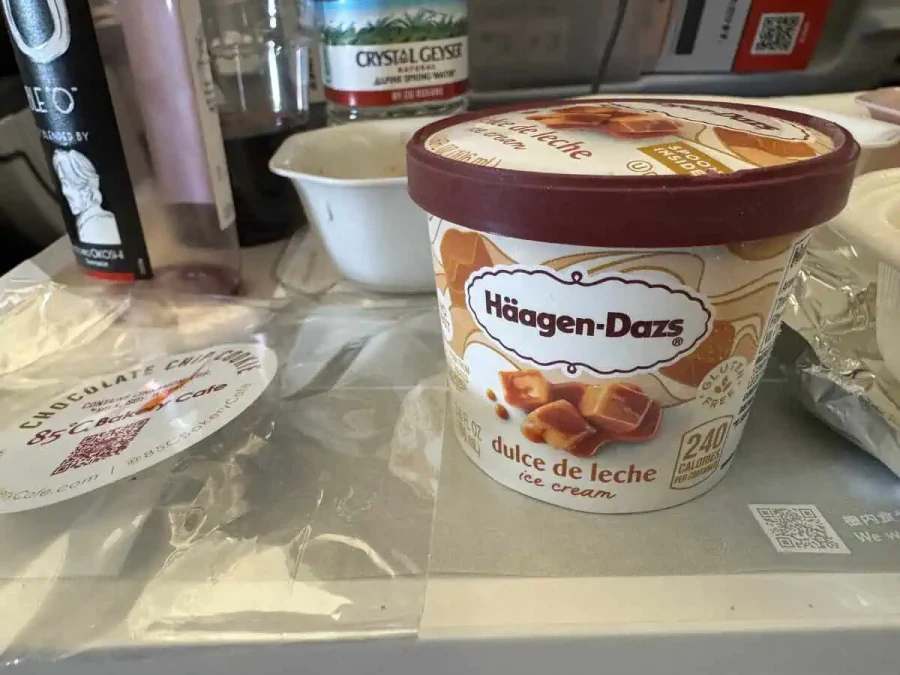
Overall, I thought this was a well-designed tray of food for Economy Class. Like, I felt the intentionality shine through in its presentation and offerings. The sides, entree, and desserts gave a variety of things for my palate to enjoy. Most of my long-haul experiences lately were American Airlines Main Cabin meals, and sometimes those feel haphazardly thrown together with a bunch of pre-packaged things so the JAL experience definitely stood out. Was this the best Economy Meal I’ve had? Maybe!
Mid-Flight Snack
For this service, there wasn’t really any announcement to foreshadow what was to come as the lights turned on about 7 hours into the flight–a rude awakening for the passengers who were asleep! But…I was awake watching magical movies (see Inflight section below).
Other than choice of drinks, there were no other options besides the standard snack for everyone: a chocolate croissant.
For my drink selection, I tried to order JAL Sky Time, which is a mix of peach and grape juices. It’s Japan Airlines’ speciality drink! But unfortunately, they told me they don’t serve it for the mid-flight service. So I settled for a hot green tea instead.

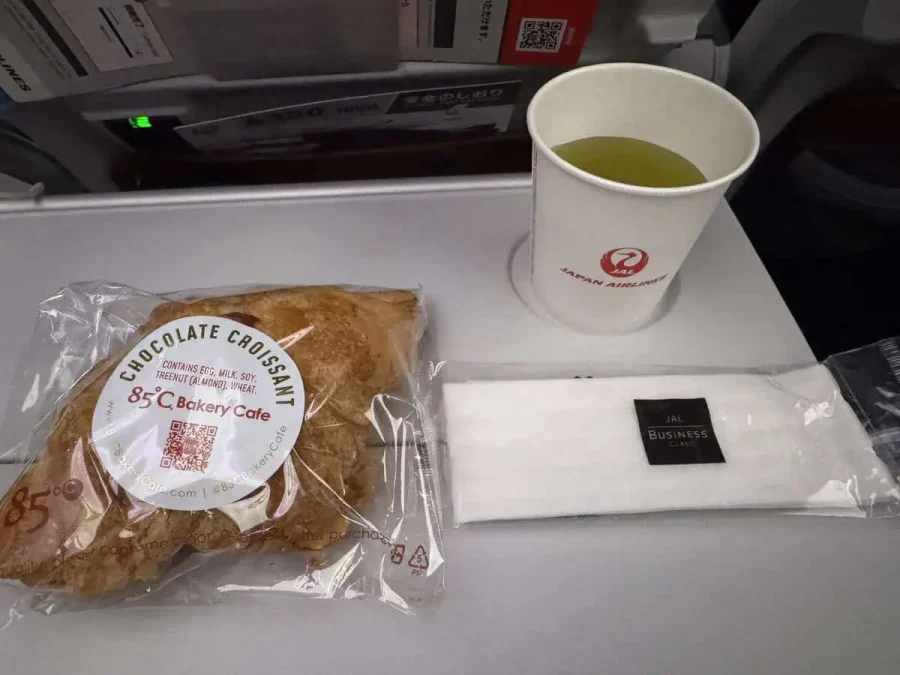
The chocolate croissant, similar to the cookie from the lunch service, was also from 85 Degrees. It was soft, and there were good chunks of chocolate inside. I kind of wished it was less of a pre-packaged thing, but I suppose that’s what Business Class is for!
I loved the simplicity of this service. Something quick and easy to help break up the long flight. As soon as the cabin crew did their trash run afterwards, the lights went back off to let everyone go back to bed.
Pre-Arrival Meal
Lastly, the pre-arrival meal in Japan Airlines A350-1000 Economy Class was served about 11 hours into the flight or 2 hours before arrival.
There was only one option for this meal, and it was more Western-like. The meal consisted of a frittata with bacon leeks, pork sausage, roasted tomato, spinach, fruits, and a cheesecake slice.
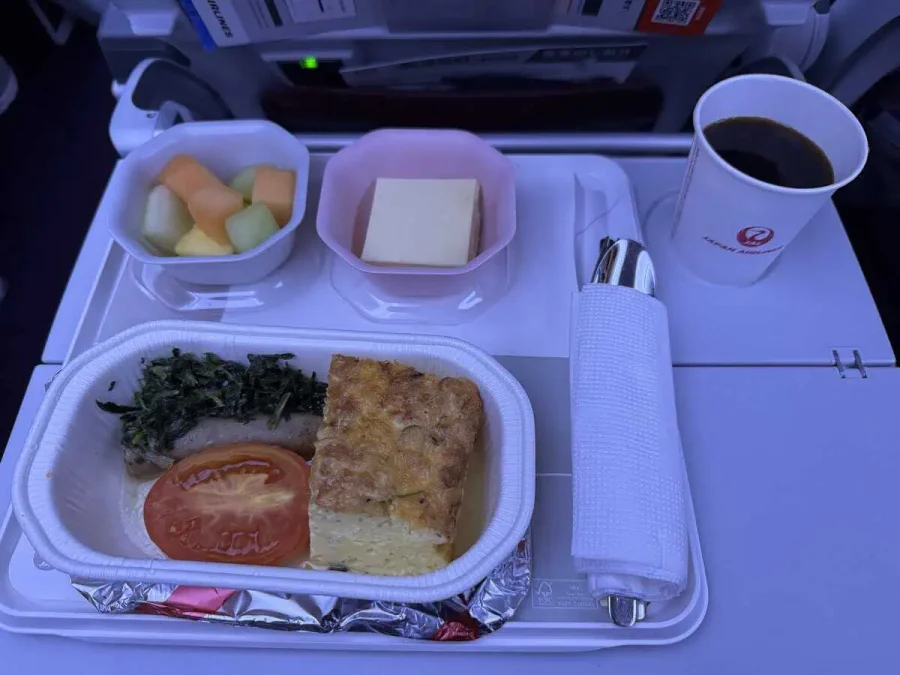
For my drink selection this time, I selected coffee. I wanted some caffeine to help me stay awake and aware enough knowing that I’d be busy running around after landing. Also, I know JAL also serves better onboard coffee (their current offerings), and I definitely tasted the difference.
The meal itself had a simple and organized presentation, and there was a little more space than the lunch service since there weren’t as many sides.
For the food, I thought it was a good lite meal to have before landing. It wasn’t gross enough that it would force me to go hunt down egg sandos at 7-Eleven as soon as I landed. The fruit plate was a good mix of melons and pineapples. I thought the frittata was fluffy and not salty, which I know tends to be a struggle with egg bites and frittatas elsewhere. The pork sausage was not dry and not super salty either. Thank goodness the roasted tomato wasn’t mushy, as I know that’s also a struggle for onboard tomatoes. The spinach was weird to me, lol. But it wasn’t bad though it was probably the strongest flavored thing on the tray. Lastly, the cheesecake was light and airy with a hint of something more than vanilla, and it tasted pretty great.
Lavatories in Japan Airlines A350-1000 Economy Class
I struggle a little bit saying how many lavatories there were for Economy Class in Japan Airlines A350-1000. From Aerolopa, it’s obvious that the 3 in the aft section of the cabin are for Economy Class. However, the back of Premium Economy has 2 lavs too, and during the flight, these lavs were mostly available to Economy as well except for the periods of time they closed the curtains. So it’s either 5 lavatories or 3 lavatories depending on how hardcore JAL enforces the use of lavs within your own cabin.
Because I was seated in 46D, technically the Premium Economy lavatories were closest to me though the ones in the aft section weren’t too far of a walk.
The left-hand Premium Economy lavatory was an accessible lav, so it had almost double the space of a normal one so that someone who needs a helper or wheelchair has room. Because of this fact, it was the most spacious lavatory.
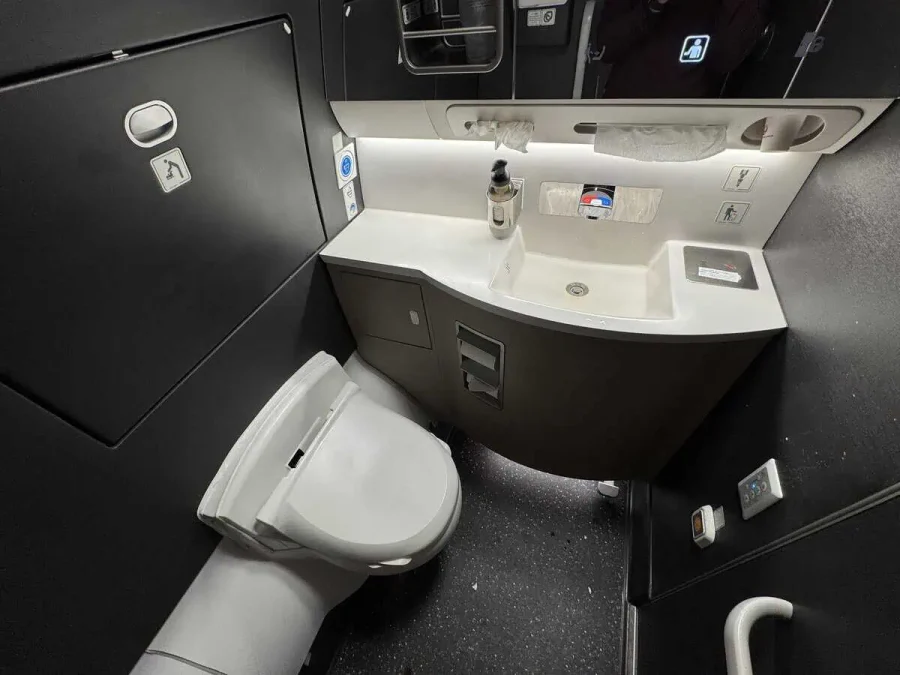
Otherwise, the lavatories are fairly standard but Japan Airlines equips their lavatories with BIDETS!!!!
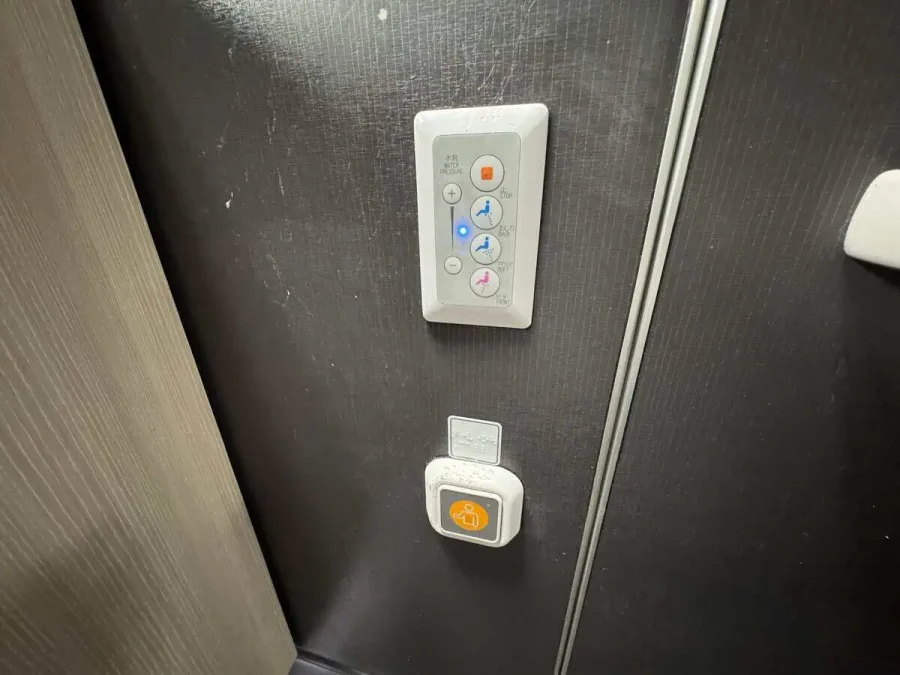
In the middle of the flight, I also used the aft lavatories. They look like this:


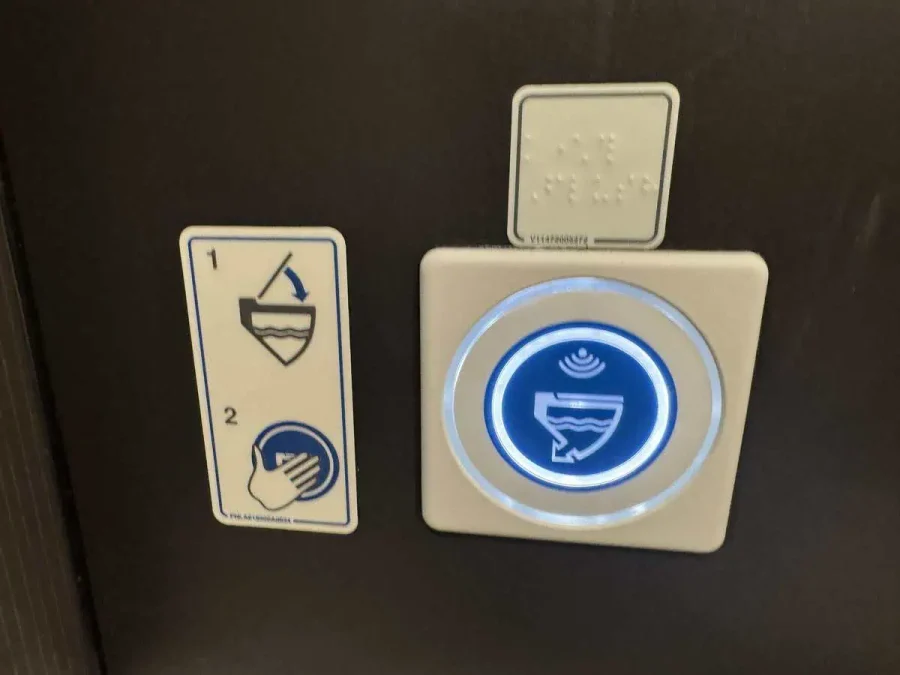
I also saw that the lavatories are equipped with more motion sickness bags and paper cups.
Personal Potty Timeline
Here’s a timeline of my use of lavatories, which one I used, and their state of cleanliness:
(hh,mm after takeoff)
- 00,57 LH Accessible Prem. Econ.: decently clean, some under surfaces of the toilet seat seemed dirty; no wet spots on ground
- 02,30 RH aft: decently clean, tighter space, lovely finishes, no debris or water on ground
- 04,53 LH aft: spotless!
- 08,25 LH Accessible Prem. Econ.: a little bit of paper debris
- 11,52 LH Accessible Prem. Econ.: some wet spots and debris on the floor, and unflushed seat cover too
I feel like they do a better job keeping the lavatories spotless in Business Class, but honestly the Economy Class lavatory experience was still pretty good and decent (i.e. much better than a US-based airline).
In-Flight in Japan Airlines A350-1000 Economy Class
Besides eating, drinking, and sleeping, I did a few other things during the flight.
During lunch, I watched The Naked Gun (2025). Oh man, I miss the 90’s style parody movies, and I thought that this was a good return to such comedy. However, I was largely distracted from actually watching the movie because of taking active notes for this flight review as well as trying to eat! Lastly, this was also the movie I was having some intermittent issues with the Bluetooth connectivity between my AirPods and the monitor. My AirPods would disconnect, reconnect with my iPhone, and then had trouble reconnecting with the monitor. I fixed this by keeping my AirPods case open and pressing the connect button kind of near the monitor.
After the lunch service, I decided to try and sleep for a while (see below). And when I woke up around 5 hours into the flight, I used the lav, came back to my seat, tried to go back to bed, couldn’t, then ultimately decided to start another movie. And that movie was Now You See Me! Prior to this flight, I had just seen Now You See Me, Now You Don’t (which is the third movie) in theaters, so I thought it would be good to rewatch the first two. Since I had already seen this movie, I also decided to bust out my Nintendo 3DS and play some Pokemon White, which I have slowly been trying to level grind my final team for the Elite 4.
Once I finished Now You See Me, I immediately went into Now You See Me 2 as the midflight snack service had just started.
Other than the movies, I mostly watched either the external camera feed or the flight map. And at various times I also listened to audio content.
All throughout the flight, much like every other flight review, I was taking detailed notes.
Sleeping in Japan Airlines A350-1000 Economy Class
I wanted to make sure that I did get SOME sleep so as to be functional enough when I landed since I planned on going to Mass (it would be Sunday when I landed) and getting myself over to my hotel to check in.
The seat came with a blanket and pillow, so I definitely used those to help me be more comfortable. Beginining in 2025, I started bringing my eye mask AND Business Class slippers that I obtained from some American Airlines flight I flew in 2024 whenever I fly long-haul Economy Class. Bringing my eye mask and slippers let me be more comfortable in an Economy Class situation by blocking out light and letting my feet not feel constricted. And that was no different here. I also sometimes used my backpack as a sort of footrest to elevate my legs a little. Otherwise, I pulled my backpack as close to the bottom of my knees as I could so that I could utilize the underseat space in front of me to stretch my legs out fully.
Between 2.5 to 6 hours of the flight was my first attempt at sleeping. I didn’t get a good amount of sleep–perhaps drifting in and out the whole time. At some point, my AirPods ran out of battery so the noise cancelling function stopped. Additionally, the gentleman in the opposite aisle seat (46G) kept fidgeting while he was trying to sleep, and the man behind him had the entire row to himself behind me so he tried sprawling out and fidgeting. In doing so, he’d kick my seat inadvertently at times, thus waking me up.
After midflight snack service, I attempted to sleep again from hours 8 to 10 of the flight. At this point, I had a headache so it was difficult for me to relax. I suspect I was dehydrated and the lack of sleep from earlier also contributed to the headache. However, I think I was able to fall asleep for a bit right before they turned the lights on for the pre-arrival meal.
I don’t think at any point towards the last bit of the flight did I feel refreshed or rested. If only I was seated in a lie-flat Business Class seat so I could get some decent and actual rest much like on the World’s Longest Flight!
Arrival at HND
| Arrival announcement | 12,44 with 40 mins left until landing |
Though I’m writing this several weeks after the flight, I’m having trouble remembering if it was the captain or the purser who made the arrival announcement. I’m leaning towards the purser. Either way, the arrival announcement was made at 12 hours and 44 minutes into the flight with about 40 minutes left until landing.
The purser sounded so official. She said there were 3 pilots and 14 cabin crew total operating this flight. I appreciated that the purser came on and said this as it made it seem like “yeah! We’re a team!”
While on approach to landing, I noticed a few things. There wasn’t any turbulence, which was great. I also couldn’t really look out the window because most of the shades were down, but at least I had the external cam feeds to watch. The best part was seeing Mt. Fuji show up at a distance in the background of the feed! And it was really cool to see Honshu island come up on the approach to Tokyo, too.
As far as how I was feeling, I mentioned in the Sleep section above that I didn’t get a lot of quality sleep. But I was able to get a brief nap before the pre-arrival meal, and I felt somewhat refreshed yet still tired from that. Also, I did feel slightly bloated, likely due to dehydration. Because of all the sitting in an upright-ish position all flight, I did feel some slight aches on my butt and shoulders.
Finally, the landing was…not smooth. Lol. During taxi, the purser came on and apologized that we would be one minute late for arrival at the gate–ONE MINUTE LATE. Apparently there was a strong headwind, and that had caused our aircraft to not fly as fast as expected. Sheesh.
Here’s a summary of the times:
| Scheduled arrival | 3:25PM |
| Touched down | 3:26PM / 13 hours, 26 minutes after takeoff |
| Gate arrival | 3:32PM / 13 hours, 31 minutes after takeoff |
| Gate to gate time: | 13 hours, 55 minutes |
I’ll just add here as an additional tip that it is advantageous to fill out the Japanese customs form on board. In the customs and immigration hall, passengers get checked and separated depending on if the form was filled out already or not so pre-filling it out saves time.
Other Stories to Share
I don’t have many short stories to share from this flight other than two interesting observations.
During boarding, the gentleman in 46G (two seats away from me/opposite aisle seat from my row) was complaining HARDCORE to some family member (I’m assuming) on the phone. I guess he didn’t book the flight himself as he kept complaining to the person on the other end of the line why they booked him in Economy Class. He said he really wanted a bigger seat like in Premium Economy or Business. I started mentally preparing myself that this flight could get awkward in case this guy ended up being insufferable throughout the whole flight, but he just watched movies or tried to sleep the whole time, even asking me how to work the monitor at one point, haha.
And then the other interesting observation I had was I noticed the older Japanese man sitting in 45C was playing on a Nintendo Switch nearly the entire flight. What game? Some sort of mahjong–I could see the tiles and virtual table. I dunno that I could spend the majority of a 13 hour flight playing a single video game haha…although I did play Pokemon White for like…4 hours…
Lessons Learned from Japan Airlines A350-1000 Economy Class
As an airline employee, I could have flown to Japan for free on my own airline. But the $109.40 I spent to fly standby on Japan Airlines to sit in Economy Class was well worth it! I thought the overall seat, service, and food was a better experience anyway. But! More importantly–I really wanted to fly JAL’s new A350.
The first lesson I learned was that because I booked this as a standby flight on not-my-own-airline, my itinerary didn’t have my Known Traveler Number attached. This meant that I didn’t get TSA PreCheck when I got my standby pass at the ticket counter. Not a problem, because at the time that I went through the security line, it was pretty open without a lot of people.
Regarding the Bluetooth capability with the screen, I thought it was a cool and very needed feature considering most people have Bluetooth headphones now. In practice, as I mentioned above, the system intermittently disconnected me, and it was a little bit of a challenge to reconnect. But the other major lesson I learned here was that it drained my AirPods’ batteries a lot. So I tried charging them when needed.
Speaking of audio-related lessons learned… I didn’t discover that the armrest itself had an audio jack until close to the end of the flight! See the picture below. I thought this was pretty cool because it gives another option for audio connection, and I suppose it would help keep the headphone cord out of the way too.
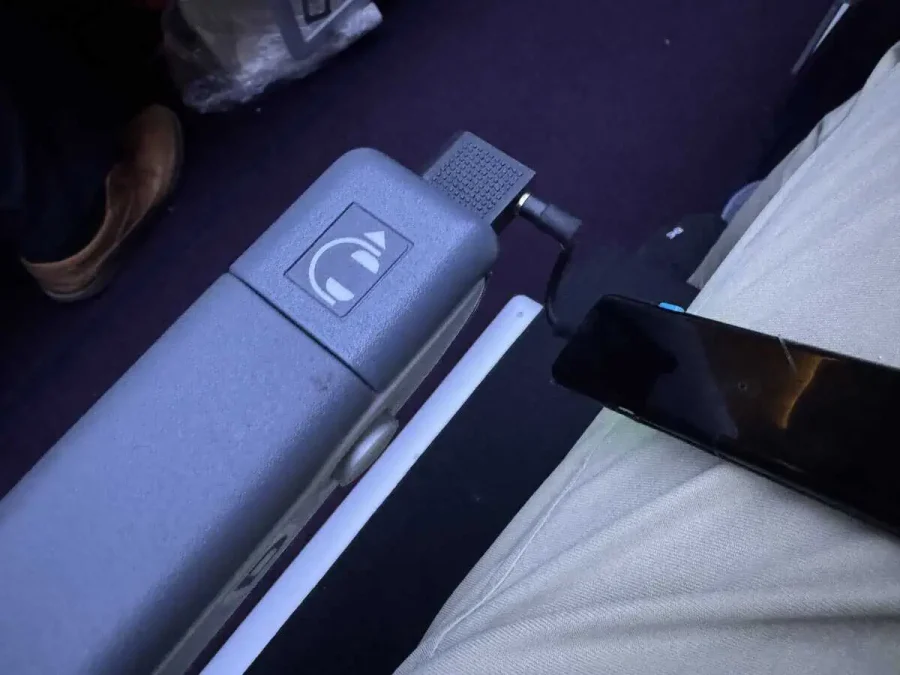
And then lastly, I also experienced that the A350 seemed to block cellular signals due to its composite construction much like the B787. This simply made it difficult for me to keep texting friends during boarding, and attempting to get my eSIM activated after landing. I don’t recall this being an issue when I flew Singapore Airlines on the world’s longest flight, but then again I was probably more distracted with being in Business Class!
Bottom Line
Though I was disappointed in not being able to find some practical, bougie way to fly to Japan in Business Class, I’m glad I landed (hah!) on the idea of flying Japan Airlines A350-1000 in Economy Class. The experience was pretty excellent for Economy Class, and I certainly thought that paying the taxes and fees of $109.40 was very worth it.
The experience on board was everything I expected out of Japan Airlines as they excelled in the small details and offered Japanese hospitality. The seat was full-featured for an Economy Class with its tech upgrades, and the meals were thoughtfully designed and presented while tasting pretty good.
Sure, I had a few minor annoyances, but the overall experience I had was a great one, and one that I’d be willing to repeat.
Do I recommend flying in Economy Class on Japan Airlines A350-1000? Absolutely! As of 2025, American Airlines has two DFW flights a day to Tokyo (1x HND, 1x NRT), and Japan Airlines has this one flight to HND. Given that AA flies either the B777-200 or B787-9 with older cabins to Japan, I definitely think that flying Japan Airlines is the better experience since JAL started flying their A350 to DFW daily.
What do you think of this flight in Economy Class? Would you pay more of a premium to experience it?
Want to read another A350 review? Check out my experience on the World’s Longest Flight with Singapore Airlines from New York to Singapore!


